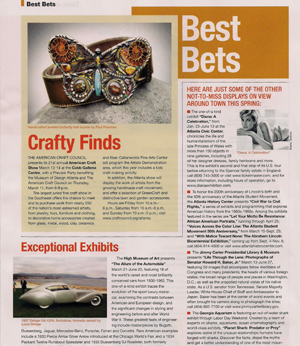
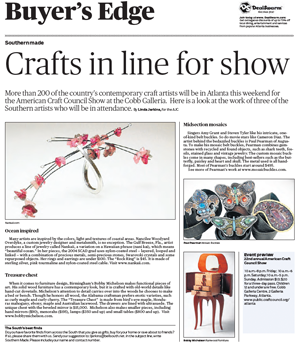
This show features Paul's work along with some of the other BCAF eco-friendly artists this weekend on Going Green with Yolanda Green.

Read the original web article here:
Paul
Pearman's work is Eco Friendly

Read the original web article here:
Paul Pearman at the American Craft Council in Minnesota
See how Paul Pearman is exploring green products, companies & ideas with an eye on design.

Read the original web article here:
Green Crafters, Part VII: Paul Pearman’s New School Mosaics
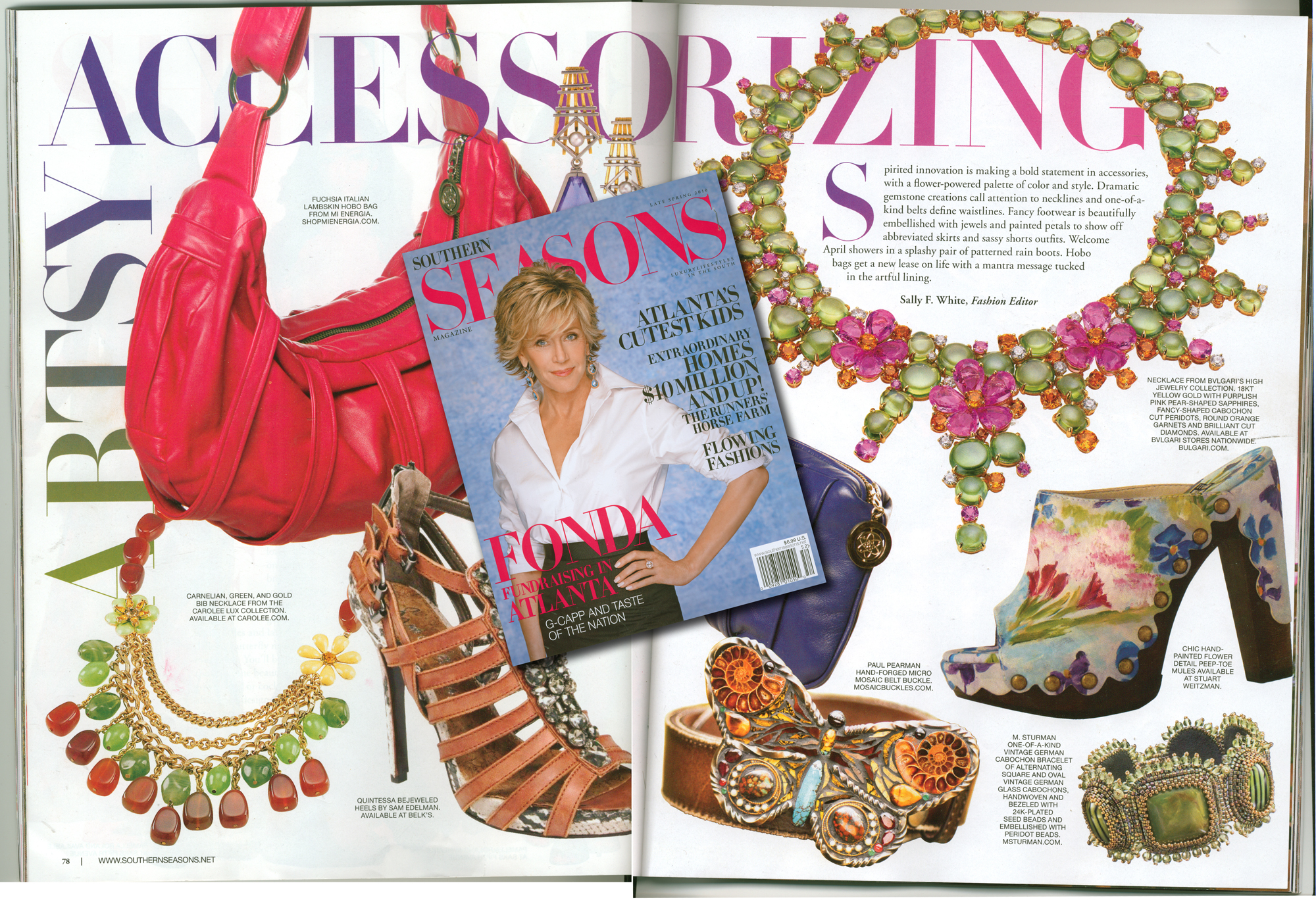
Artist Paul Pearman makes art for your hips with wickedly stylish mosaic belt buckles.

(read the original web article here.)
Or download the article via PDF here. - (PDF file)
ACC Show Atlanta 2009 from KPKinteractive on Vimeo.
Art in the Park
Editors Note: It's the last day of the Bayou City Art Festival, so we're reposting this guide to some artists worth checking out:
What do a field of golden Humpty Dumpties, a mosaic belt buckle depicting Van Gogh’s Starry Night, and a child with a balloon riding a blue bull all have in common? If you’re stumped head to Memorial Park and search the booths of the Bayou City Art Festival.
This outdoor celebration of contemporary American art and craft runs Friday through Sunday, and if you’re willing to pony up $10 for admission, you’re guaranteed the artists will explain their work before you buy. Twice a year the Art Colony Association presents the Bayou City Art Festival with a spring festival in Memorial Park and an autumn festival downtown (October 9-10).
The festival combines the best of a juried art show with the approachability of a carnival, featuring food, fun, countless performances organized by the Houston Arts Alliance, and 300 artists, selected from 1200 applicants, eager to talk about their creative labors, the products of which are available and on sale. No doubt this atmosphere helped earn the festival a nod from AmericanStyle magazine as one of the top 10 art festivals in the country.
Ransacking 300 hundred booths may seem daunting, but make sure you tear yourself away from the theater, folk dance, flamenco, and other absorbing performances. Here are some artists worth finding:
Vic Lee has Houston in mind in his haunting but playful Waiting to Fly featuring a blue bull with rider poised before a Houston skyline. It was created specifically for the Bayou City Art Festival as the featured artwork, so it appears on most of the festival’s promotional materials.
This provides great exposure for an artist who was first a soccer player, an athletic club owner, a cartoonist, and a student of theology before religious quandaries encouraged him to pick up a brush and create distinctive renderings of a world wearing a halo of mystery. Lee’s painting began in response to religious questions, and his career should be encouraging to artists trying to get a start.
“I have no art training,” he says, but “I can’t help but believe that within us all is a messenger in search of a delivery system.”
Norberto Clemente also finds artistic inspiration in the revelations of religion. This Cuban-born, Houston-based artist manages to be surreal, expressive, disciplined, and colorful all at once. Portraits of saints co-exist with human-animal hybrids and inviting tropical landscapes. Also self-taught, Clemente felt his calling at a young age and though he describes art as “a wild beast,” his paintings are polished and often serene.
You may wish Paul Pearman would create custom mosaics throughout your entire home, but you can visit this Augusta, Ga., artist and walk away with a custom belt buckle lively enough for any Texan. Pearman works in a variety of media but primarily glass. He is, as mentioned, the master of the buckle, mounting “Art for the Hips” (Van Gogh’s Starry Night) on waistlines rather than museum walls. But he’s also an expert in stained glass, sculpture, and graphic design. For a black belt and the 1989 Guinness World Record for the longest skateboard jump (over 26 barrels), Pearman’s artistic philosophy is suitably bold: “Thinking outside the box is one thing – not having a box is another.”
He may have fallen but Humpty Dumpty rises again in the quirky sculpture of Minneapolis artist Kimber Fiebiger, last year’s Bayou City Art Festival featured artist. These golden beauties begin with a steel rebar skeleton before coatings of clay, plastic, and other materials prepare the way for the bronzing. If you can’t resist cracking into some of these works, a small sculpture the size of an actual chicken egg won’t set you back too badly.
The latest sports car of your dreams may be out of reach in this economy, but Jay Garrison’s “Found Object Assemblages” might prove equally delightful and far less expensive. These “conversation pieces” as he calls them — cars, motorcycles, planes, trains, and balloons — may not fly, but they do fascinate. It’s as if the leftover pieces of something you assembled yourself were collected and then crafted into fantasies of locomotion. “Recycling at its finest,” Garrison calls it, but there’s plenty of sweet novelty in these found objects.
The Bayou City Art Festival lets you play arts patron, but best of all KTRH 740 AM sponsored a “People’s Choice” slot in the festival. Ten artists vied for the crown. Check out the choices and the winner.
Watch the 24th Annual American Craft Council Show Teaser here.
See how Paul Pearman's art goes green.
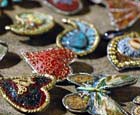
Paul Pearman boasts a wide variety of creative talents, including graphic design, sculpture, stained glass, painting and mosaics. He even made a living for a while knocking off the work of Van Gogh. Inspired by art nouveau and impressionist styles, he carefully places the glass in his mosaics to emulate the movement and direction of brush strokes. In addition to cut glass, he embellishes his work with semi-precious stones and exotic materials including coral, opals, turquoise, emeralds, jasper, ancient shark’s teeth, and the occasional carved skull.
Just as the impressionist masters before him, before art, Pearman started out as a kick boxer and a skateboarder. He captured the 1989 Guinness World Record for the jumping his skateboard over 26 barrels, snatching the record away from the previous title holders, Renoir and Monet, who purportedly turned to painting to console themselves over their loss.
Anyway, back to belt buckles. Paul was caught off guard by the success of his custom-designed mosaic belt buckles, which have garnered placement in high-end boutiques and galleries and attracting celebrity clients who pay from $500 to $3500 for his work. The response has created an endless workload for him, trapping him in self-described “belt buckle purgatory” in his basement studio, as he scrambles to keep up with demand. What the video below for the back story.
So visit New School Mosaics if you would like to own one of these unique creations or simply because you think it would be cool to keep Paul toiling away in his basement a little longer.
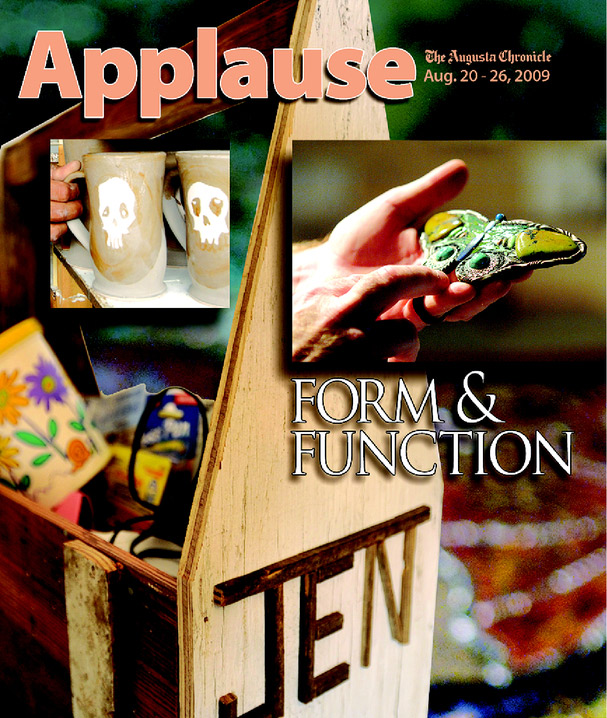
Paul Pearman’s work featured in the Applause section of the Augusta Chronicle.
|
![]() ![]() ![]() ![]() ![]()
|
|
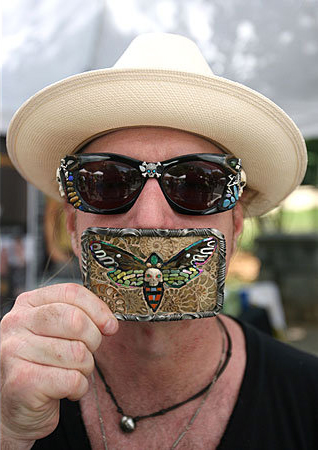
Paul Pearman shows off his 'Silence of the Lambs' belt buckle during SummerFest 2009. |
||
“We grew up with the world stopping in Augusta the week of Masters. The whole week was nothing but cocktail parties and brunches,” Lucy Shuler says to me, recounting her childhood in this Georgia city along the Savannah River. We’re sitting among friends at our own leisurely brunch...
It’s not Masters week, the first full week in April when hundreds of thousands of golf fans descend on Augusta for the Masters Tournament. But there’s still a steady stream of people in and out of the eatery tucked next to the city’s historic Summerville neighborhood. Outside, an elderly couple walks by, still in their Sunday church clothes. Inside, local mosaic artist Paul Pearman is mixing drinks at the Bloody Mary bar, talking about how much of his time surprisingly is now spent on handmade belt buckles with a growing customer base of celebrities like Keith Richards.
Over mimosas and omelets on the sun-drenched porch of Crum’s on Central, Shuler and I are talking golf. Rather, we’re talking the social side of golf, both things that ratchet up springtime in Augusta, the only city to routinely host one of the four men’s golf majors each year. I asked her to stop by, because if anyone is qualified to give the lowdown of Augusta’s Masters parties it would be her.
Shuler, a descendent of the city’s first mayor, spent much of her life here, except while going to school in Columbia. Her grandparents attended the first Masters Tournament in 1934, mostly out of civic duty. A few years earlier, Clifford Roberts and acclaimed golfer Bobby Jones had purchased 365 acres of nurseries land for the Augusta National Golf Club, now the azalea-laden, world-renowned golf club known as one of the most exclusive in the world.
Like many Augusta families, Shuler’s would host out-of-town friends and families, staging backyard parties and dinners when they weren’t on the course watching the tournament. The atmosphere makes the medium-sized city come alive every April, but it’s largely fueled by visiting companies’ hospitality tents and catered parties.
Her foodie-friendly Simply Kitchen store at nearby Surrey Center is just one of many boutique-style stores in the center that attracts the secondary Masters crowd—namely golfers’ wives and au pairs. Sweet children’s items and gifts fill the shelves of Charleston Street, a distinctly Southern shopping spot, while upscale clothing items tempt from the windows of Soho, Susan’s, and Village apparel shops. The plaza also serves as a main hub of after-hours activity during Masters week because of its proximity to Augusta National and its mix of bars and live entertainment venues, as well as fine dining restaurants.
On this day, my companion and I head to Surrey for an early dinner at the French Market Grille—one, because too many years have gone by since I last sampled their towering peanut butter pie, and two, because it’s a prime destination for any Masters crowd. Chuck Baldwin, a golf fanatic himself with three holes-in-one on record, opened the casual, Louisiana-cuisine restaurant with his wife in 1984.
As I am eyeing the crawfish rémoulade and blackened grouper that has arrived at a nearby table, head chef Scott Guyer tells me about the seafood bounty that rolls into his establishment for April. At least 2,000 lbs. of shrimp. More than a hundred cases of oysters. An eighteen-wheel trailer truck full of food arrives daily during Masters week to feed the golf-shirt-and-khakis crowd, says Guyer. And every day, the truck is emptied and refilled for the next round of patrons.
It hasn’t been so long since I lived in Augusta, and recollections of the town when it is at its early-April peak seem not-so-distant memories: sidewalks brimming with foot-weary yet ebullient multitudes donning khakis, Polo wind-breakers, and Masters-logo caps. Restaurants accommodate the crowds by setting up beer coolers and oyster bars in their parking lots. Churches and schools sell parking spaces by Jackson bills.
It goes without saying, Par-3 Night—which is to say the Wednesday after the Masters Tournament’s Par-3 contest has ended, just before the official tournament starts the next morning—tends to get the most rowdy. People often migrate to Surrey Center for tailgating, socializing in and around the crowded restaurants, or catching one of the soulful R&B bands known to grace the stage at Surrey Tavern, whose Masters week celebrations frequently spill out into the surrounding shopping center.
Washington Road—which exits off Interstate 20, is home to the National golf course, and serves as the cluttered, chain-restaurant laden commercial strip that runs through the town—proves another popular spot, despite drawing many a snarky comment from writers covering the tournament. A heavily congested thoroughfare, Washington Road is a stark contrast to the pristine and genteel grounds inside the course’s gates. Yet this is where action pulsates as fans pour into the restaurants and bars, bustling and conveniently located.
The strip, however, is fiercely avoided by veterans who know to forego the neon chaos for less-obvious shops in Augusta’s downtown district or around Summerville, the city’s historic corner that hugs the Surrey Center, along with eateries on and around Walton Way, an oak-tree lined, antebellum-home laden corridor. On downtown’s Broad Street, Still Water Tap Room serves mostly locals seeking to avoid the crush of out-of-towners. Old photos of Augusta from the turn of the century hang on its walls; a young man stares somberly out from a vintage version of downtown, mid-calf in water from a massive flood in 1908. In drier and happier times, people now fill the beer pub. I have a pint while talking with Katie Ashley, who has lived in Augusta most of her life, and I ask her where she usually ends up Masters week.
“Locals try to avoid all the congestion,“ she sa“I think downtown is one of the most underrated areas of the city, and I think all the Masters visitors are missing out.”
Downtown features an Artists Row, a collection of galleries and unique boutiques housed in early nineteenth-century storefronts along Broad Street. The wide thoroughfare (for which it earned its name) served as a stage to a young James Brown who often performed for soldiers in exchange for pocket change. The 900 block of Broad is also home to the Augusta Common, an open greenspace with plenty of benches for lounging and grassy area for children to play. The Augusta Museum of History, the Savannah River Riverwalk, the National Science Center’s Fort Discovery museum, and the Morris Museum of Art all are within downtown’s walkable boundaries for those who prefer history and culture to egg salad sandwiches and fairway views.
But more frequently, the real attractions during Masters week are the off-the-beaten-path retail spots, places like Bonaventure Discount Golf store, a 10,000-square-foot warehouse located on a frontage road by the Bobby Jones Expressway (named after the golfer who helped found and make successful the Masters Tournament). Stacks upon stacks of women’s golf shoes extend toward the ceiling, and a thirty-foot-long line of golf bags extends into the distance, making the spot a frequent pilgrimage for those in search of bargain golf gear.
Midway through our trip, we decide to venture across the Savannah River, over a bridge that separates Augusta from South Carolina. I’m curious about a relatively new development that has sprouted up on the other side of the river’s banks. It’s one of those neo-traditional neighborhoods with homes reminiscent of old Charleston, townhouses above retail space and sidewalks close enough to encourage neighbors to talk to each other from their porches.
On one of the rooftops in Hammond’s Ferry, we enjoy an overhead, late-afternoon view of a three-acre organic farm owned by the community, and in the opposite direction the buildings of downtown Augusta line the horizon, just above the rocky shoreline of the river. The neighborhood is still quiet and growing as homeowners move in, but Manuel Verney-Carron says his café (Manuel’s Bread Café, its counters filled with fresh-baked breads and mammoth cupcakes, not to mention plates of mussels steamed in white wine and shallots emerging from the kitchen) has already become a central gathering spot for the neighborhood.
Verney-Carron has a longtime history with Masters crowds as general manager and chef at an upscale restaurant in Augusta called LaMaison on Telfair. The native of France said he was attracted to the neighborhood-bistro idea because it reminded him of European town centers. Though across state lines, Manuel’s Bread Café is only about five miles from Augusta National.
He says the homes of Hammond’s Ferry are expected to rent out en masse to out-of-town golf visitors, and, in addition to the restaurant, he expects to be busy with catering orders throughout the week. Many of the people who come into town, the golf patrons who throw lavish parties where he cooks up a custom menu of international fare, return year after year.
Though we almost always stay with friends, there are countless hotel rooms available around the city and, depending on the size of your party, homes to be rented out. One of the hottest reservations in town is a room at the Partridge Inn, with its pale stucco exterior, nineteenth-century décor, and stellar service that has been lauded as the epitome of Southern hospitality. This historic 1892 hotel sits in the heart of the Summerville neighborhood atop a large hill overlooking the city and boasts 145 guest suites, as well as a grand dining room that offers up three meals a day, Sunday brunch, and a bar and lounge for the after-hours crowd.
Indeed, as our trip comes to a close, we find ourselves looking toward Masters week. For with seemingly endless cocktail parties to enjoy and brunches to linger over, not to mention azalea bushes in bloom and three-putts to lament, it goes without saying Augusta is at its peak in spring but at its finest in early April.
French Market Grille at Augusta’s upscale Surrey Center offers a Louisiana-inspired menu, with an emphasis on seafood. 425 Highland Ave., (706) 737-4865, www.frenchmarketaugusta.com
Crums on Central’s reasonably priced menu, including a briny olive tapenade on warm pita points and sausage grinder for brunch, encourages hanging out, especially on the open front dining porch. 1855 Central Ave., (706) 729-6969
Manuel’s Bread Café is a neighborhood bakery and European-style bistro in the Hammond’s Ferry neighborhood in North Augusta. 505 Railroad Ave., North Augusta, SC, (803) 380-1323, www.manuelsbreadcafe.com
The Swank Co., located at Surrey Center, has gifts and knickknacks to satisfy anyone’s frivolous side, from ginger-pomelo countertop cleaner to bejeweled cocktail shakers. 351 Highland Ave., (706) 364-3421, www.theswankco.com
Simply Kitchen has enough shelves of gadgets, Le Creuset cookware, and spices to function as a grown-up toy store for cooks. 463 Highland Ave., (706) 667-6266
Midtown Threds downtown Augusta boutique mixes together vintage
Western shirts for men and modern dresses for women. 1022 Broad St., (706) 821-3111
The historic 145-room Partridge Inn, established in 1892, features a second-floor veranda perfect for dinner or evening cocktails, and a Sunday brunch spread popular with locals and visitors. 2110 Walton Way, (706) 737-8888 or (800) 476-6888, www.partridgeinn.com
Fasten your seatbelts, Augusta, because Mr. Pearman’s Wild Ride starts at his Lake Olmstead house and ends with his artwork adorning Keith Richards.
AUGUSTA, GA. - Paul Pearman has lots of friends in Augusta. They don’t buy his art.
“They say, ‘You know, I went to high school with that fool. I’m not paying $400 for a belt buckle.’” Pearman laughs.
Of course, $400 is last year’s price. Pearman’s elaborately decorated buckles are so hot today that the prices have soared as high as $3,500 for his most detailed work.
That may explain why so few of Pearman’s fellow Richmond Academy graduates wear his work.
But Keith Richards has one. And Tanya Tucker. And Mötley Crüe singer Vince Neil.
“Paul ought to be bigger than Augusta,” said Molly McDowell, owner of the Mary Pauline Gallery on Broad Street. He’s on his way.
Pearman’s work at local boutiques, such as Soho and powerhouse bling-broker Windsor Jewelers, is only the beginning. The self-trained artist has become a star at trunk shows and arts festivals such as the Virginia-Highlands Festival. Late last year, he was scouted by chic boutique Fred Segal — frequented by celebrities such as Madonna and Lindsay Lohan. He was featured in the December issue of Lucky magazine and in the People magazine fashion show. He just finished interviewing with Southern Living about his home décor.
British luxury yacht designer and decorator Don Starkey, winner of several International Superyacht Design Awards, recently began using Pearman to design tiled interiors.
Starkey works on contracts for 75- to 200-foot yachts by companies like Alloy, Abeking & Rasmussen and Royal Van Lent. Pearman’s designs grace the interior bathrooms, kitchens and bedrooms of these floating palaces for clients such as Revlon billionaire Ron Perelman, Oracle Corporation founder Larry Ellison, Bayliner founder Orin Edson (he makes boats, but they’re small boats) and the Arisen family (who own Carnival Cruise Lines, so you wouldn’t think they’d need a bigger boat).
Pearman has also settled into a relationship with the influential Horn Fashions, with boutiques in Los Angeles and Berlin, whose stores are featured in In Style, Elle and Harper’s Bazaar. The shops are frequented by the likes of Cameron Diaz, Kate Winslet and Heidi Klum. Horn has outfitted the actresses of “Vegas,” “Charmed” and VH1’s “The Fabulous Life of the ‘It’ Girls.”
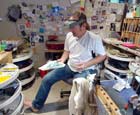
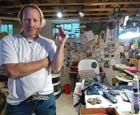
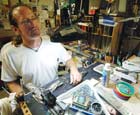
Pearman may brush celebrity fairy dust off his shoulders, but, if you saw him working, you wouldn’t recognize the celebrity. Most days, Pearman sits in his dungeon-like basement with his hair in a ponytail, wearing paint-spattered grey sweatpants and a T-shirt printed with “The Kiss” by Gustav Klimt. Friends say they’ve seen him wear it a hundred times.
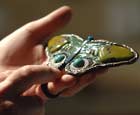
He perches in a swivel chair at an old-school drafting table littered with dental tools honed to a fine point. His supplies are organized — sort of — on rotating shelves. A giant wall-mounted tack board serves as his filing system, featuring the remains of past projects and the models for future ones. When he holds an ornate butterfly belt buckle up to his mouth, I’m afraid he might tell me to rub the lotion on my skin or else I’ll get the hose again.
The only visible indication of his success is the flat screen TV on the basement wall across from him. It’s constantly tuned to nature-channel documentaries. He has this one about giant man-eating snakes memorized.
“Look at the size of that thing!” he exclaims, nodding his head at a reticulated python chomping on an unsuspecting police officer’s arm. “That’s a different kind of illegal alien, man. That’s not a busload of Mexicans.”
Conversations with Pearman jump like jackrabbits. He’ll talk about his wife, Michelle, then his two Dachshunds, Chloe and Pupster (who would very much like to eat the ankles right off your legs, thank you very much). He describes the weird lavender mushroom he found in his yard, his new property acquisition on the shore of Lake Olmstead and finally gets back to his artwork. He is exhausting and entertaining at the same time, like riding Space Mountain at the end of a long, hard acid trip.
Gallery owner McDowell said that it’s a strength that Pearman does not think in a linear fashion.
“He has childlike energy and enthusiasm,” McDowell said. “I think that there’s something that’s really charming about Paul as well, and that might be part of it, too. I work with a lot of quirky artists. His enthusiasm for his work and what he does is part of it as well.” Perhaps because of the way his mind works, Pearman is not a member of the PC crowd.
He speaks his mind and despises what he calls “the milquetoast mentality.” It’s probably the kind of thing that kept him out of galleries when he was a young painter. That’s fine with him now.
“Galleries that would never have given me the time of day, now instead of me beating down their doors, they’re calling me,” he says, without a hint of reproach. Instead, he wears a dazed expression like the kind you see after someone’s had a brush with death or won the lottery.
“I’m an old man. I forgot to make money the first half of my life. But this money thing is really cool. I like money. I’m not used to it. Then I can buy cool saws and $1,500 worth of rare turquoise. This starving artist shit is for the birds.”
It didn’t take long for Paul Pearman to find art. At Richmond Academy, he often skipped biology and math to attend extra art classes. “Nothing was ever said about it,” he chuckled.
It took longer for art to find him.
Pearman has always painted, heavily influenced by art nouveau, impressionism, Antonin Gaudi and Gustav Klimt. He tried for years to find gallery representation, not that it would have made much of a difference since he sold everything he painted. But a pass into the sometimes-hierarchical world of fine art is not often given to a skateboarding, kickboxing high school graduate.
He set a world record for the longest skateboard jump ever (over 26 barrels), as documented by the Guinness Book of World Records. He competed as a ranked amateur kickboxer with a third degree black belt, winning state and national championships belts. But all the while, he painted.
He did residential work, painting giant reproductions of famous paintings that his clients could never even think about bidding on if museums would part with them. An old refrigerator in a space adjoining his living room is covered with a hand-painted reproduction of van Gogh’s “Starry Night.”
“I used to literally copy van Goghs for a living. There were all these gay guys in Atlanta who just had to have van Goghs,” Pearman laughs.
The van Goghs paid the bills, and anyway, Pearman can never be called pretentious. He admits his influences. Heck, he built a business on them.
His painting was always inspired by the art nouveau movement’s stylized, curvilinear designs. His models: the patterns and textures in Gustav Klimt’s paintings, the Barcelona architecture by Gaudi and the forms found in the natural world. When he turned to mosaics, it was to Gaudi’s trencadis form of mosaics created from broken tile shards, also called pique assiette. Then he Pearmanized it.
Pearman makes his mania work for him. Traditionally, art nouveau works in nature with pictures of water lilies, seashells and dragonflies. Pearman’s work includes those and combinations of lunar moths, sunflowers, butterflies and… skulls. Well, skulls are natural.
“One day I was looking up at all them mosaics people were doing and I thought: ‘That looks horrible. They need to be thinking like a painter, because painting has rules,’” he says.
Painters begin with the foreground and build into the background. Mosaic is the opposite of painting: background first, foreground last. Dark colors first, light colors last. But unlike painting, mosaics can’t be done over, so Pearman must be design-minded.
“I hate random, broken color. I call that ‘soccer mom mosaic.’ You know: ‘Armed with a hot glue gun and a holster, here they come,’” He laughs.
It’s not that he has something against soccer moms. It’s that Pearman sees no room for error. With a floor installation, owners can’t be worried about a grandchild skidding over tiles that might cut bare feet. Adults don’t want to worry about slicing their hand on a fireplace insert and ruining a romantic evening. So Pearman’s tiles are grouted to stay — like Pompeii. Especially with the materials he uses, a secret epoxy weapon whose manufacturer just offered him free product in return for allowing them to use photos of his work. He declined. His secret would no longer be safe. No one can know the identity of the masked man.
“Basically, it’s just me by myself. I’m on the bench like the Lone Ranger for 20 hours a day. I work all the time,” he says.
Pearman’s belts are his mainstay, his bread-and-butter and his bane.
“I set out to make me a belt buckle, one belt buckle, and now look what happened,” he laughs.
Belt buckles aren’t cohesive to mosaic work. So he partnered with local metal sculptor Thomas Lyle (he taught local artist Chris Murray) to develop a spun metal edge for his buckles. The idea sprang from the old-school Spanish architecture that he loves so much.
“But it’s never been done on a belt buckle, at least as far as my lawyer can find. The hard part is design. Art is problem solving,” he says. And Pearman has spent his life solving problems. From how to jump 26 barrels with his skateboard to how to keep his ass (and his face) from getting kicked in boxing matches. Now his tenacity is paying off — and to some extent, ripping him off. Imitation may be the sincerest form of flattery, but it’s also the quickest way to hit an innovator’s pocketbook.
“If somebody sees the problems you have solved, it’s easy for them to emulate you,” he says. “That’s why I went for a copyright, a trademark and a patent. People are all the same; if they can find an easy way out, they will.”
It’s one of the reasons he doesn’t hire art students.
“You get some young art student kid and all of a sudden he’s like, ‘Hey, look what I figured out. I invented it,” he says.
It’s one of the reasons he’s stopped doing decorative home pieces like mirrors and clocks, because similar pieces began showing up in the galleries in which he sold his work. The artists would use glass or cheap materials and undercut him in price. The Tiger’s Eye, emeralds, shark’s teeth, nautilus fossils and koroit opals in Pearman’s work don’t come cheap. But they make an impact, McDowell said.
“He’s pushing it, so it’s edgier. You can go to any store and see big, chunky belt buckles, but he has a great sense of color and a great sense of materials,” McDowell said. “He’s got his design aspect down so well that then he gets to play with the concept. I think he’s going to do great, great, great if he keeps up the level of work he’s doing.”
And if the sincerest form of flattery is any indication of success, Pearman is already drawing imitators. A woman in Atlanta began calling herself the Mosaic Goddess and doing pieces that mimic Pearman’s work in a rougher, less refined manner. Her designs — which Pearman admits he didn’t invent — are so similar as to make one do a double-take. But put the two side-by-side and it looks like a child’s rough-edged drawing next to a master, like a schoolchild tried to copy da Vinci’s 1490 creation “Vitruvian Man.”
McDowell laughs when she thinks of people copying him. She said that people come into the Mary Pauline Gallery and frequently remark that they could duplicate whatever is hanging on the gallery walls.
“I tell them, ‘No, you can’t. You can’t do that because that’s not you. That’s not your soul; that’s not your person.’ Every time I’ve had someone try, they say, ‘Oh, it was miserable. I tried, it didn’t turn out well.’”
And the imitation hasn’t affected his sales. For now, Pearman complains he can’t keep up with demand. In advance of a holiday show in Chicago, he needed to make 400 buckles. A month before, he only had 100 because people kept buying them.
“I can’t keep a butterfly with a skull,” he shakes his head. “I tried to hire some people to help me, but it’s just not as easy for someone else,” he shrugs. “And I’m probably very hard to work for.”
Besides, in an art form that admittedly is nothing new, Pearman stands out. He strives for his glass to look like paint strokes and to have movement and direction. He has improved upon the technique, developed his own style and given a centuries-old method of expression a new life.
“He’s taken old concepts and old ideas and essentially hit a new level. Italy is loaded with these mosaics that are everywhere, but I think Paul’s got a whole new twist on it,” McDowell said. “I think it lives in his quirkiness as an artist, just taking it to another dimension.”
So he labors daily in his basement studio, surrounded by exotic semiprecious and precious stones. “Look at that,” he says, flashing a multicolored opal. “Have you every seen anything like that? It’ll hurt your feelings.”
Despite his excitement over new materials — skulls from a bone-carving shop in China, emeralds from Brazil — and his excitement about new contracts and a growing bank account, Pearman’s true love is in big installation pieces. He has two (shh!) public commissions coming up, but he won’t release details to the public because he worries about jinxing the projects. He’s afraid of the hoodoo?
“Oh, you know how it is,” he says, with a dismissive wave. “Nothing ever goes the way you want it to.”
His residential installation business is booming. One Columbia County riverfront homeowner, with quite the imagination and it seems more money than Midas, is having him design and install a concave floral glass mosaic on a staircase ceiling. McDowell herself has put her landscape architect on notice that Pearman’s design for a tile work patio insert takes precedence over the rest of the design.
“It’s really kind of changed the whole dynamics of the project and I’m so excited about it and my husband keeps going, ‘Oh, my gosh. What has this turned into?’” McDowell laughed.
But despite his residential success, don’t expect him to buckle under the pressure and spend his time reworking the Sistine Chapel.
“I really like the big projects, but the money is in the little pieces. I always joke that the name of this company should be Sin No. 3.”
That would be vanity. But perhaps a better choice would be gluttony. After all, buyers don’t just purchase one of his buckles. They buy new ones all the time. Pearman maintains a mailing list of past and present buyers, which does very well for him. His success is still something of a shock to him. Years of skateboarding and kickboxing competitions didn’t give him much to bank on. So he won’t pass up the opportunities that roll his way.
“I never get off this bench and if I do get off this bench, I’m somewhere that I shouldn’t be. Wherever. I should be here. Because, you know, the light doesn’t always shine on you. I’m going to do this while I can.”
Visit newschoolmosaics.com.

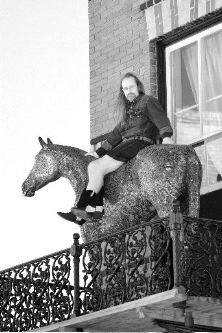
Paul's work can be seen all throughout the Garden City. His three dimensional mosaic designs are on signs, mirrors, clocks, and even equine sculptures in Augusta. But lately, Paul has ventured into a new artistic arena: fashion. His mosaic belt buckles (www.newschoolmosaics.com) are becoming stylish must-haves for local fashionistas. Complete with vintage leather straps, exotic stones and glass buckles, Paul says the belts are his attempt at functional art, and the response to his latest venture has been tremendous. "It's been amazing," he says. "The belts are selling out the minute they hit the boutiques."
What he likes best about reading skirt!? "Now more than ever, I'm curious about what women want and how they think."
And what he likes best about wearing a skirt? "I love knowing that obviously there are no boundaries on my shameless self-promotion."
If you are interested in getting a Paul Pearman custom design, call 706-667-9535 or contact us at